
You’ve planned a great sale. The discounts are strong, the products are in store, the signage is ready and your team is briefed. You’ve posted on Facebook and Instagram, and maybe even sent a newsletter. And yet, the traffic isn’t living up to your expectations.
It’s a situation many Canadian retailers know well. The instinct is to assume the discount alone should be enough to drive foot traffic to your store. Not necessarily: in retail, a great offer isn’t worth much if it isn’t seen by the right people, at the right time, in the right context.
The real problem isn’t always the price. It’s often visibility.
A sale strategy shouldn’t only answer the question “What discount should I offer?” It also has to answer a far more important one: how will I let interested shoppers know that my sale exists? This article explains why your discounts aren’t enough to generate traffic, and how to promote your sales to shoppers who are already in buying mode.
In this article
- Why isn’t a discount enough to drive foot traffic to your store?
- Who are “deal-seeking shoppers” and why do they matter for clearances?
- Are social media enough to make your sale known?
- Can your newsletter attract new customers on its own?
- Is storefront signage enough to generate traffic?
- When should you announce your sale to maximize traffic?
- Why do sale periods amplify buying intent?
- How do you frame an offer that gives a real reason to visit?
- Why advertise on a specialized platform like allsales.ca?
- Why doesn’t a discount replace a real sale strategy?
- How do you make sure your next sale gets seen (and pays off)?
Why isn’t a discount enough to drive foot traffic to your store?
You can sell quality products at very competitive prices and run a genuinely advantageous clearance. But if the information doesn’t spread far enough, your sale will stay limited to customers who already know you or to passersby who see your window. That isn’t enough.
Today, consumers are exposed to an enormous amount of information: promotions, ads, newsletters, social posts, notifications, local listings. Attention is fragmented, and your sale competes with every other commercial message.
There’s a big difference between interrupting someone with an ad and appearing in front of a person who is actively looking for deals. In the first case, you’re trying to create interest. In the second, you’re capturing interest that already exists — exactly what an in-store sale needs.
A discount only attracts when it’s seen.
Who are “deal-seeking shoppers” and why do they matter for clearances?
Focusing all your promotion on your existing customers makes sense: your loyal customers know you and are easy to reach. But for a clearance meant to move a volume of products fast, you sometimes need to go beyond your usual base.
This is where many businesses underestimate deal-seeking shoppers. They may not follow you on Instagram, don’t walk past your store every day, and wouldn’t have bought at full price. But they’re ready to travel if they see an offer that fits their needs.
Their value isn’t limited to that first basket. A customer drawn in by a discount can discover your store, appreciate your service, sign up for your newsletter, follow your socials or come back for your next sale. But first, they have to know you exist.
Are social media enough to make your sale known?
Social media let you showcase products, humanize your brand and announce a promotion quickly. But be clear-eyed: you can have 2,000 followers and reach only a fraction of them with a post. Even a good piece of content can disappear fast in the feed.
That doesn’t mean you shouldn’t post — quite the opposite. A post reminds followers of your sale, a story creates urgency, a video shows the in-store atmosphere. But social shouldn’t be your only channel. To attract customers who don’t know you yet, you need other touchpoints. Visibility shouldn’t depend on a single algorithm.
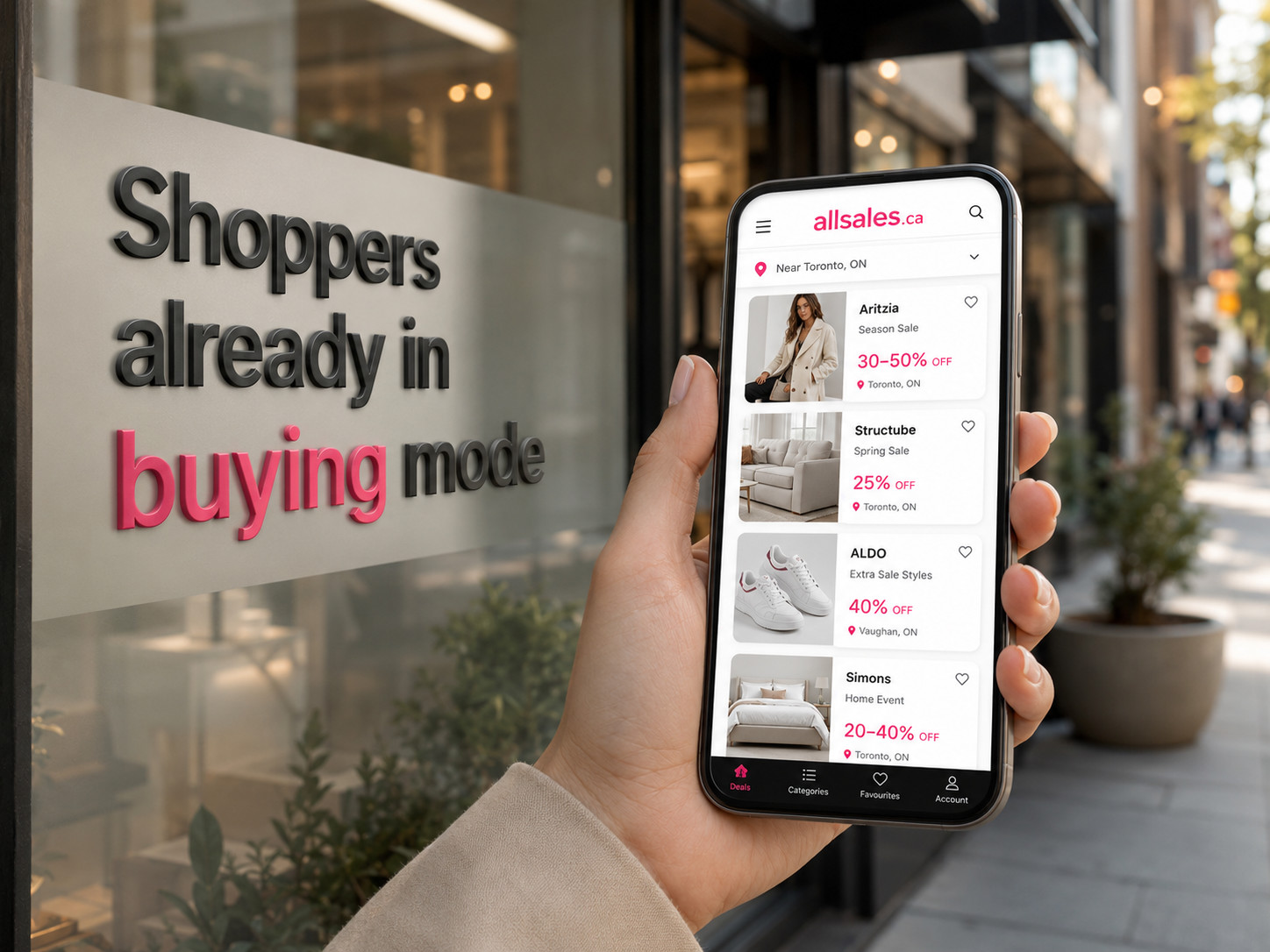
Related: see how retailers in-store sales appear to shoppers already browsing for deals on allsales.ca.
Can your newsletter attract new customers on its own?
Email marketing remains an excellent tool. A good newsletter can generate traffic quickly, especially if your list is engaged. It’s ideal for announcing a pre-sale, offering VIP access or reminding people of a clearance’s final days.
But it mainly reaches people you already know. If your goal is to attract new visitors, the newsletter isn’t enough. A strong sale strategy combines two objectives: re-engaging your existing customers and attracting new buyers. Both are necessary.
Is storefront signage enough to generate traffic?
If your business sits on a busy street or in a high-traffic mall, signage plays an important role. But if your goal is to increase traffic, you need to reach people before they’re standing at your door.
Someone planning a shopping day looks ahead for where to go: which stores have sales, what products are on offer, which discounts are worth the trip. If your sale is only visible in the window, you lose every buyer who would have come had they been informed earlier.
When should you announce your sale to maximize traffic?
To create traffic, think in sequence. Ideally, your communication follows several moments:
- announce the sale before it begins;
- remind people on launch day;
- highlight star products or categories during the sale;
- create urgency in the final days;
- send one last reminder in the final 24 to 48 hours.
This repetition isn’t excessive — it’s necessary. Consumers may see your offer, forget it, see it again, talk about it, then come a few days later. The bigger the sale period, the more crucial this reminder work becomes — because if you’re only visible once, you risk dropping off their radar.
Why do sale periods amplify buying intent?
During a strong promotional period, the consumer isn’t short on offers — they’re short on clarity. They want to quickly know which sales are worth their attention. That search habit is very real: industry research in Canada notes that on-site placements capture high-intent shoppers close to the point of purchase (IAB Canada).
Your announcement should therefore be simple, precise and convincing. It clearly answers: what’s the discount? which products are included? where is the sale? when does it start and end? why act now? The clearer your message, the easier it is for the customer to decide.
How do you frame an offer that gives a real reason to visit?
Saying “Big in-store sale” is useful, but often too vague. Saying “Up to 70% off winter coats, boots and accessories — in store only, until Sunday” is far stronger. Precision increases perceived value.
Several elements strengthen a sale announcement: a clear percentage, a limited window, specific product categories, a note about limited quantities, an address or geographic area, a seasonal reason and a direct call to action. For example: “Summer clearance: up to 60% off dresses, sandals and swimwear. Final days in store.” Simple, but it gives a reason to act.
Why advertise on a specialized platform like allsales.ca?
Not every channel plays the same role. Your social media nurture your community, your newsletter activates your base, your window captures passersby. A platform specialized in sales and promotions places you in front of buyers who are already in research mode — exactly the context a clearance needs.
On allsales.ca, you aren’t just one more post in a social feed: you’re a relevant option in an environment where the user is already deciding what to buy or where to go. The same logic applies to measurable online advertising, which Canadian retail experts note can drive offline foot traffic, not just online clicks (Digital Main Street).
| Criterion | allsales.ca | Generic social media ads |
|---|---|---|
| Audience intent | Visitors already in buying mode, looking for deals | Browsing audience, interest still to be created |
| Ad validation | Every ad manually reviewed | Automated delivery, variable quality |
| Reach | Not dependent on a single feed algorithm | Subject to algorithm changes |
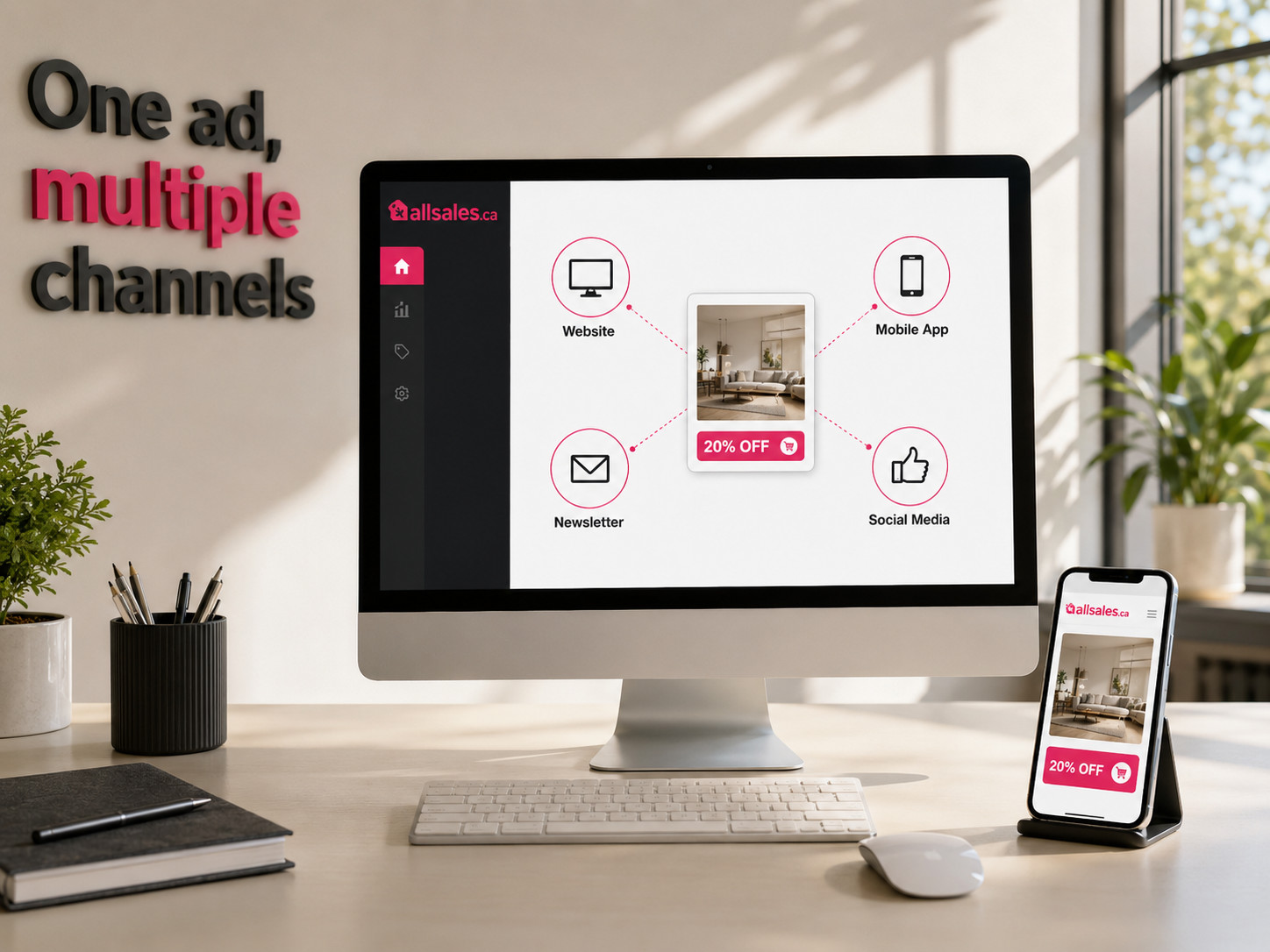
| Distribution | One ad, multiple channels: website, mobile app, newsletter, social media | One channel at a time, to be multiplied yourself |
| Canadian audience | 200,000+ Canadian shoppers, 71,000+ newsletter subscribers | Broad audience, targeting still to be built |
Put your offer in front of shoppers already in buying mode
One ad, multiple channels: website, mobile app, newsletter and social media. For 16 years, allsales.ca has connected 200,000+ Canadian shoppers looking for deals.
Have a question? Contact a specialist.
Why doesn’t a discount replace a real sale strategy?
Strategy is the set of decisions that let your discount produce a result: product selection, depth of reductions, calendar, in-store presentation, communication, targeting, follow-ups and measurement. Without it, a discount can simply reduce your margin.
That’s why you should plan your sales like commercial campaigns, not just price cuts. A campaign has a goal: clearing specific surplus, boosting traffic in a slow period, helping shoppers discover your store, preparing a new collection or capitalizing on a strong season. Your answer shapes the message, the channels and the calendar.
See what other advertisers say about their results in our client testimonials.
How do you make sure your next sale gets seen (and pays off)?
Your discounts can be excellent, your products appealing, your team ready. But if your sale isn’t visible enough, your results will stay limited. Social media, the newsletter, signage and advertising all contribute to your success — but for a clearance, also think about the consumers who are already looking for deals and don’t know you yet.
They’re often the ones who turn a decent sale into a real success. Before your next summer sale or winter clearance, ask where consumers look for sales before they head out. If your store isn’t visible there, you’re leaving potential traffic to your competitors.
A short glossary for promoting your sales
- Buying intent
- The state of a consumer already willing to buy or compare. Capturing existing intent takes less effort than creating it from scratch.
- Organic reach
- The number of people who see a post without paid distribution. It depends on the algorithm and reaches only a fraction of your followers.
- Acquisition vs. retention
- Acquisition attracts new customers; retention re-engages those you already have. A good sale campaign combines both.
- Qualified audience
- A public whose profile and behaviour match your offer — here, Canadian shoppers actively looking for deals.
- 1,000-click guarantee
- The commitment of allsales.ca’s 100% Homepage package: 1,000 clicks or your next ad free — a unique offer in Canada.
Frequently asked questions
Why aren’t my discounts attracting more customers in store?
Most often the problem isn’t the price — it’s visibility. An excellent offer stays invisible if it isn’t distributed where consumers are already looking for deals. Multiply your touchpoints and be present at the right time.
How many times should you communicate a sale before it happens?
Think in sequence: announce before the start, remind on launch day, highlight star items during the sale, create urgency near the end and send a final reminder in the last 24 to 48 hours. A single message isn’t enough.
Why advertise on allsales.ca rather than only on social media?
Because allsales.ca visitors are already in buying mode: they come looking for discounts and promotions. You capture existing intent, from shoppers who don’t follow you yet, with a single ad distributed across the website, mobile app, newsletter and social media.
About allsales.ca
For 16 years, allsales.ca (the English edition of lesventes.ca) has been Canada’s go-to digital media for sales and clearances: a professional website, a mobile app and an online advertiser platform connecting 200,000+ Canadian shoppers in buying mode, 71,000+ newsletter subscribers and nearly 1M TikTok views.










Social Contact